What Is a Funding Rate? How Perpetual Futures Stay Anchored to Spot
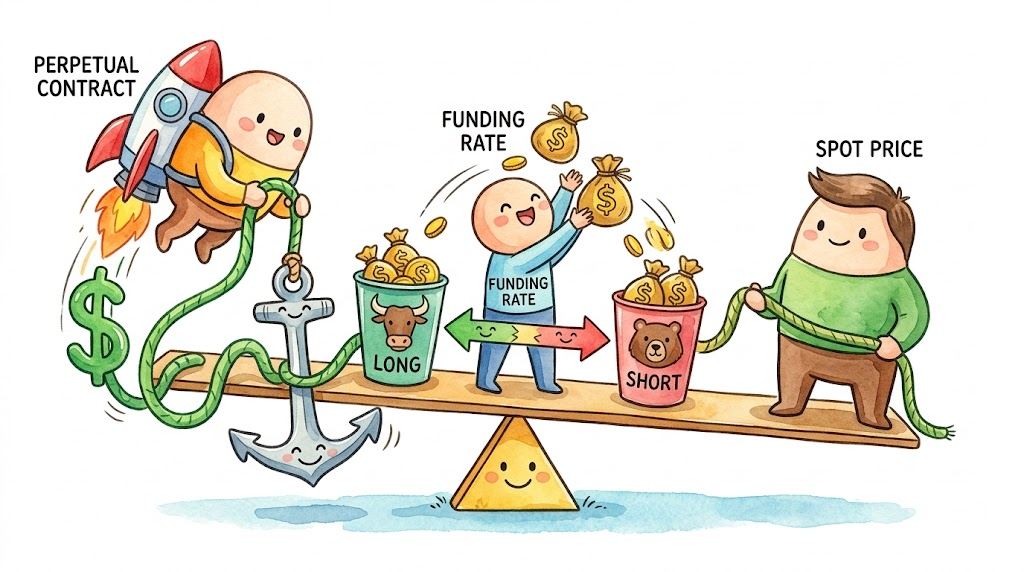
The funding rate is a periodic payment exchanged between long and short traders in the perpetual futures market. Its core purpose is to keep the price of a perpetual contract, which has no expiry date, anchored to the spot price. Whereas delivery futures rely on an expiry date to force convergence, perpetual futures use this continuous cash-flow mechanism to turn the gap between the contract price and the spot price into a holding cost, giving market participants an incentive to push the price back toward a reasonable range.
Why Do Perpetual Futures Need a Funding Rate?
Traditional delivery futures rely on their expiry date to ensure that the contract price converges with the spot price. Perpetual futures have no expiry date, so the contract price can stay away from the spot index for a long time and build up systemic risk.
The funding rate turns that deviation into a holding cost:
- When the perpetual price stays above the index, the side holding long positions generally bears a positive cost.
- When the perpetual price stays below the index, the side holding short positions generally bears the opposite cost.
How Is the Funding Rate Calculated?
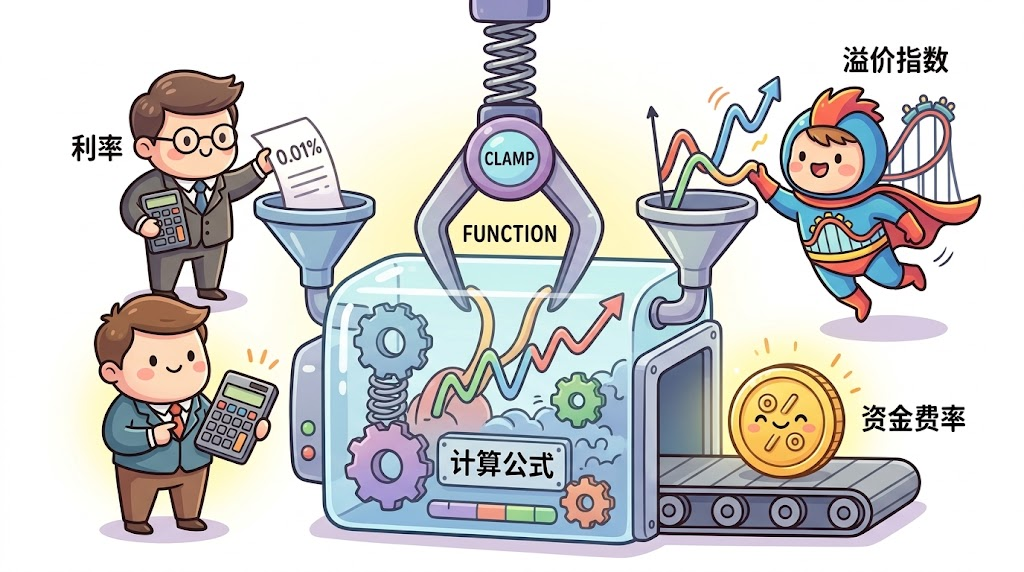
The funding rate is made up of two core components: the interest rate and the premium index.
Interest rate: This reflects the difference in borrowing costs between the base currency and the quote currency. Exchanges usually set a fixed daily interest rate, for example 0.03%, and then convert it for the settlement interval. With an 8-hour settlement cycle, the rate per cycle is 0.03% / 3 = 0.01%.
Premium index: This is the more dynamic part of the funding rate. It reflects how far the perpetual contract deviates from the spot price. The premium is positive when the contract trades above spot and negative when it trades below spot.
Formula (general form):
Funding rate = average premium index + clamp(interest rate - average premium index, lower bound, upper bound)
The clamp function keeps the adjustment inside a reasonable range, such as ±0.05%, so the rate does not swing excessively.
Specific parameters can differ between exchanges. Bybit, for example, uses a time-weighted average premium index, where data closer to the settlement moment carries more weight; Gate upgraded its algorithm to a time-weighted average in 2026.
How Does the Funding Rate Work?
Funding settlement takes place directly between long and short holders. The exchange does not collect this fee.
- When the funding rate is positive: the perpetual contract trades above spot, meaning bullish sentiment is strong, and longs pay funding to shorts. This raises the cost of holding longs, prompts some long holders to close, and encourages arbitrageurs to short the contract while buying spot, which pushes the price down.
- When the funding rate is negative: the perpetual contract trades below spot, meaning bearish sentiment is strong, and shorts pay funding to longs. This cools bearish sentiment, draws longs back in, and pushes the price up.
Settlement usually happens every 8 hours, as on Binance, Bybit, and OSL. Some platforms or special contracts may settle every 4 hours or every hour.
What Funding Rates Mean in Practice
The funding rate is a cost of correcting the price, not a direct signal of price direction. A high positive rate does not necessarily mean the price is about to fall. When a trend is strong and outside capital keeps flowing in, a crowded long position can last a long time, and the price may keep following the trend even when the rate is high.
The more practical value of the funding rate lies in:
- Measuring market crowding: extremely positive rates often reflect excessive bullish leverage, while extremely negative rates reflect excessive bearish leverage.
- Assessing holding costs: long-term positions should include funding costs in profit and loss. For example, a funding rate of 0.01% per hour corresponds to a monthly holding cost of about 7.2%.
- Arbitrage opportunities: when the rate is positive, shorting perpetual futures while buying spot lets traders earn the funding fee with price risk hedged.
Frequently Asked Questions (FAQ)
Q1: Is the funding rate a fee charged by the exchange?
No. Funding fees settle directly between long and short positions. The trading platform only handles matching and calculation and does not collect this fee.
Q2: When the funding rate is positive, who pays whom?
When the funding rate is positive, usually because the perpetual contract trades above spot, longs pay funding to shorts.
Q3: Do I have to pay funding fees?
You only pay or receive funding if you hold a position at the settlement moment. If you close before settlement, you do not take part in the funding settlement for that cycle.
Q4: Do funding rates matter much for long-term positions?
Yes, significantly. For example, if the funding rate stays positive at 0.01% per hour, the monthly cost of holding a long position is about 7.2%. Assess this ongoing cost before holding a position over the long term.
Related tutorials:
- Complete Guide to Futures Trading: From the Basics to Risk Control
- Leverage Trading Explained: Amplifying Gains and Risks Alike
- What Is Futures Trading? Perpetual vs Delivery Contracts
- What Is Futures Liquidation? The Forced-Liquidation Mechanism and Liquidation Price
Recommended reading:
Inirerekumendang pagbabasa
Tingnan ang higit pa