Private Keys and Seed Phrases: The Last Line of Defense for Digital Assets
A private key is used to sign transactions, while a seed phrase is typically used to recover a set of derived private keys. Anyone who obtains a valid private key or seed phrase may be able to bypass the wallet interface and directly control the associated assets.
How Are Private Keys, Seed Phrases, and Wallets Related?
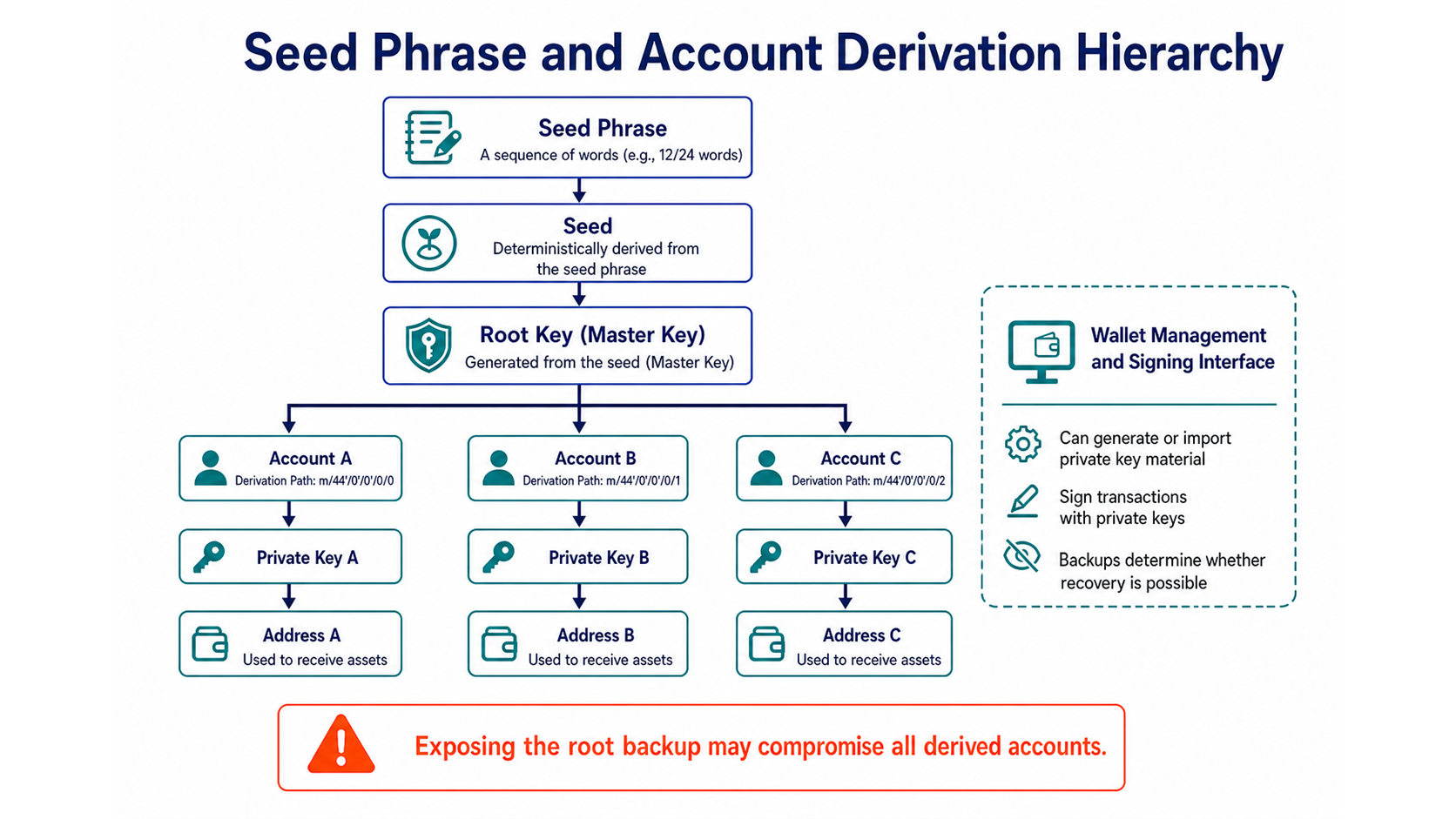
Digital assets are recorded on the blockchain. A wallet stores or accesses the keys required to sign transactions. The private key creates a signature, and the network verifies authorization using the corresponding public key or address information without requiring the user to send the private key over the network.
Many hierarchical deterministic wallets use one root seed to derive numerous accounts. A BIP39 seed phrase encodes random entropy and checksum information into words that people can write down, then uses those words to generate a seed. Some wallets use other backup and derivation standards, so you should not assume that every seed phrase will restore the same addresses in every application.
Exposure and Loss Are Opposing Risks
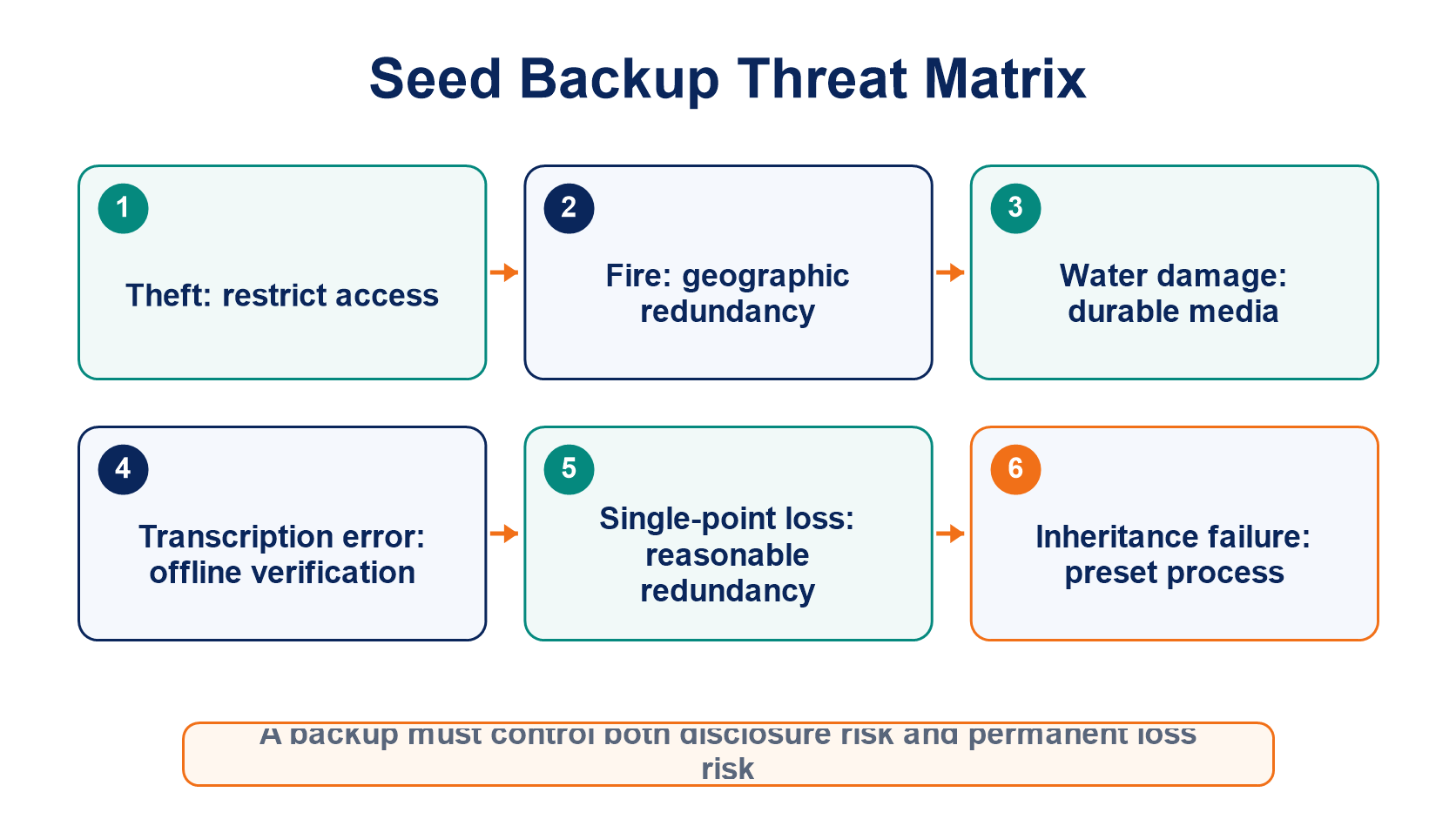
Too few backups can permanently cut off access after device failure, fire, or an interrupted inheritance process. Too many copies increase the risk of photography, theft, or accidental entry into an unsafe interface. A sound security plan must protect both availability and confidentiality.
| Event | Main consequence | Appropriate response |
|---|---|---|
| Device lost, backup remains secure | Recovery is possible in a compatible environment | Confirm the device has been revoked, then recover securely |
| Seed phrase lost, wallet still accessible | Future recovery will be impossible | Create a new wallet and migrate before the device fails |
| Seed phrase or private key exposed | An attacker can duplicate control | Create a wallet with new secrets and move all assets |
| Wallet app password exposed | Impact depends on the device and encryption design | Change the password, inspect the device, and determine whether keys were exposed |
A Practical Backup Plan
Generate the seed phrase offline on a trusted device and record every word accurately in its original order. Do not take screenshots, send it through chat, or upload it to cloud storage. Keep at least two physical backups in separate, access-controlled locations, and use tamper-evident seals or access records to detect interference.
Practice recovery only in a trusted, compatible environment. The purpose is to confirm the words, their order, any optional passphrase, the derivation path, and the expected addresses. Do not repeatedly enter a real seed phrase on an everyday internet-connected phone.
Write clear location and operating instructions for inheritance or incapacity scenarios, but keep the secret separate from the complete instructions. A custodian should know how to locate and follow the legitimate procedure without being able to obtain full control alone during normal circumstances.
Wallet Security Goes Beyond Key Backups
A hardware wallet can keep private keys inside a dedicated signing device, but it cannot judge malicious contracts on the user's behalf. Multisignature arrangements can remove a single-device failure point, yet signer selection, thresholds, and module configurations introduce their own risks.
Separate wallets used for everyday interactions from those used for long-term storage, review token approvals regularly, and test the process before moving a large balance. Anyone who asks you to enter a seed phrase on a website to “sync,” “verify,” or “unlock” a wallet is not trustworthy.
Continue reading about how private keys work, seed phrase backups, hardware wallets, wallet security models, multisignature wallets, token approval management, what to do after crypto is stolen, wallet migration, and private key sharding and social recovery.
Frequently Asked Questions
Will My Assets Disappear If the Wallet Company Shuts Down?
On-chain assets do not automatically disappear when a wallet interface shuts down. Whether you can recover them depends on the backup standard, derivation path, and compatible tools. Record this information while the service is still operating normally.
Does the Order of Seed Phrase Words Matter?
Yes. Entering the same words in a different order will produce a different result or fail the checksum. Always preserve the original order.
Is It Safe to Split a Seed Phrase in Half and Store the Parts Separately?
A simple split may reveal substantial information if either half is exposed, and it also increases the risk of losing part of the backup. If you need secret sharing, use a defined threshold scheme and verify compatibility before relying on it.
Why Can a Wallet Address Be Public but a Private Key Cannot?
An address is used to receive assets and identify an account. A private key can generate valid authorization signatures. Their permissions are fundamentally different.
Recommended
View more