
How Is a Futures Liquidation Price Calculated?
A futures liquidation price can be worked out from the entry price, leverage, and maintenance margin rate. Long and short positions use different formulas, and you can get a fast estimate either with an exchange calculator or by applying the formula yourself.
In futures trading, the liquidation price is the core metric for risk control. Knowing how it is calculated helps traders judge their safety margin before opening a position and avoid being liquidated quickly because of excessive leverage. This guide walks through the calculation logic and how to apply it in practice.
What the Liquidation Price Means
The liquidation price is the level at which, once the market price reaches it, the exchange forcibly closes the position to stop account losses from exceeding the margin.
The main factors that affect the liquidation price are:
Entry price
Leverage
Position side (long/short)
Maintenance margin rate
Isolated or cross margin mode
Trading fees and funding rates (included in some calculations)
The Simplified Liquidation Price Formula
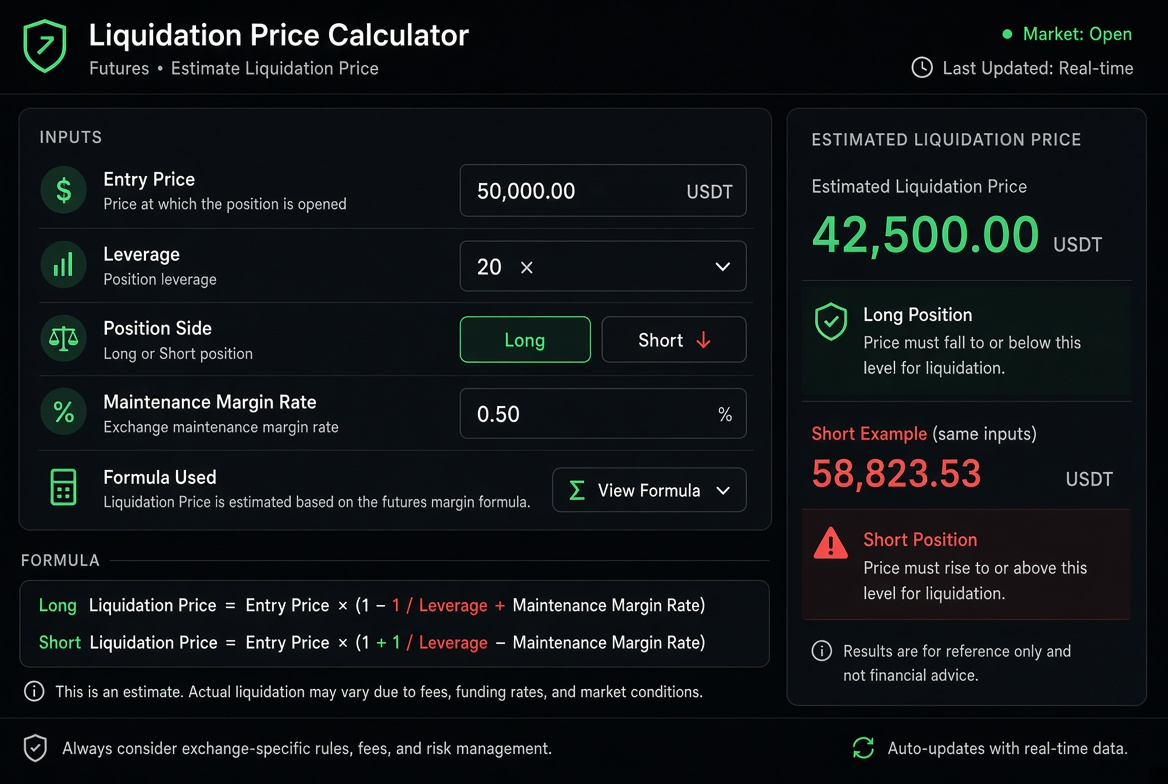
The formulas below are common simplified estimates (actual rules depend on each exchange):
Long liquidation price ≈ Entry price × (1 – 1/Leverage + Maintenance margin rate)
Short liquidation price ≈ Entry price × (1 + 1/Leverage – Maintenance margin rate)
A more precise calculation also takes trading fees and funding costs into account. Maintenance margin rates differ between exchanges, so the results differ too.
How to Calculate the Liquidation Price with a Tool (Step by Step)
Open the contract calculator built into an exchange (Binance, OKX, Bitget and others all provide one).
Choose the position side: long or short.
Enter the entry price, leverage, position size or margin amount.
Select the margin mode (isolated/cross).
Click calculate to see the estimated liquidation price.
Adjust the leverage or the entry price and run several simulations to see how the liquidation price moves.
After opening the position, watch the distance between the current price and the liquidation price on the positions page.
An official calculator is more accurate than doing the math by hand, and it is a practical gain that few top-ranking results explain systematically.
How to Read and Use the Liquidation Price Correctly
Safety margin: the further the current price sits from the liquidation price, the better the position absorbs volatility.
Leverage effect: the higher the leverage, the closer the liquidation price to the entry price, and the greater the risk.
Isolated versus cross: in isolated mode a liquidation affects only that position; in cross mode the entire available balance of the account is used, which makes the liquidation price far more complex to calculate.
Dynamic changes: funding rates, added margin or a smaller position size all shift the actual liquidation price.
Points to keep in mind:
The formula is only an estimate; the actual liquidation price is set by the exchange system.
Slippage can occur in extreme markets, and the actual fill price may be worse than the marked liquidation price.
The maintenance margin rate is adjusted as the value of the position changes.
FAQ
**Q1: How do long and short liquidation prices differ?**A: For a long, a falling price moves toward liquidation; for a short, a rising price does. The formulas run in opposite directions.
**Q2: Why does the actual liquidation price differ from the calculator result?**A: Possible reasons include adjustments to the maintenance margin rate, funding rates, trading fees, a gap between the mark price and the last price, and liquidity slippage.
**Q3: What happens to the liquidation price when leverage is raised?**A: The higher the leverage, the closer the liquidation price to the entry price, the smaller the safety margin, and the more sharply liquidation risk rises.
**Q4: Can the liquidation price still be calculated accurately in cross margin mode?**A: In cross margin mode the liquidation price is affected by other positions and the account balance, so the calculator result is only a reference and the real outcome is more complex.
**Q5: What should beginners focus on when calculating the liquidation price?**A: Focus on the distance between the liquidation price and the entry price and on the maximum drawdown you can tolerate, rather than simply chasing high leverage.
With the methods above, users can master how a futures liquidation price is calculated and use tools to estimate risk quickly. Make calculating and simulating a habit before every position, and pair it with strict position management to keep liquidation risk under control in futures trading. Markets swing hard, and staying rational and disciplined is what keeps you in the game over the long run.
Recommended
View more